


🌱 🌱 🌱 Hello! I’ve been busy in the past two months with some personal matters but that’s finally concluded and I’m excited to get back to researching and writing at a more regular cadence.
To start, I’d like to introduce you to James Wang, an accomplished venture capitalist and Bridgewater and Google X alumnus. James authors this issue’s guest post where he attempts to answer whether OpenAI is overpriced.
He writes a newsletter called Weighty Thoughts where he shares his unique and on-the-ground perspectives of AI and “deep tech” investing. I highly recommend it.
Without further ado, here’s James’s guest post, “What AI really is—and is OpenAI overpriced?”.
What AI really is—and is OpenAI overpriced?
What is AI, really?
There’s an old USSR joke of an old man answering questions about cities.
Where were you born? “St. Petersburg.” Where did you grow up? “Petrograd.” Where do you live? “Leningrad.” Where do you want to live? “St. Petersburg.”
The joke, of course, is these are all the same city in different eras of Russian history.
In a way, the same thing is true of “artificial intelligence” today. What used to be simply statistics became machine learning, which then became artificial intelligence. “Old timers” like me—which is weird, since it wasn’t that long ago—who were in the statistical/machine learning era were always leery of applying the concept of “AI” to what we did. After all, most popular machine learning textbooks start with GLMs (generalized linear models)… which includes linear regression, which every high school student learns.
So, what are we actually talking about today?
But enough history: why do we care about this?
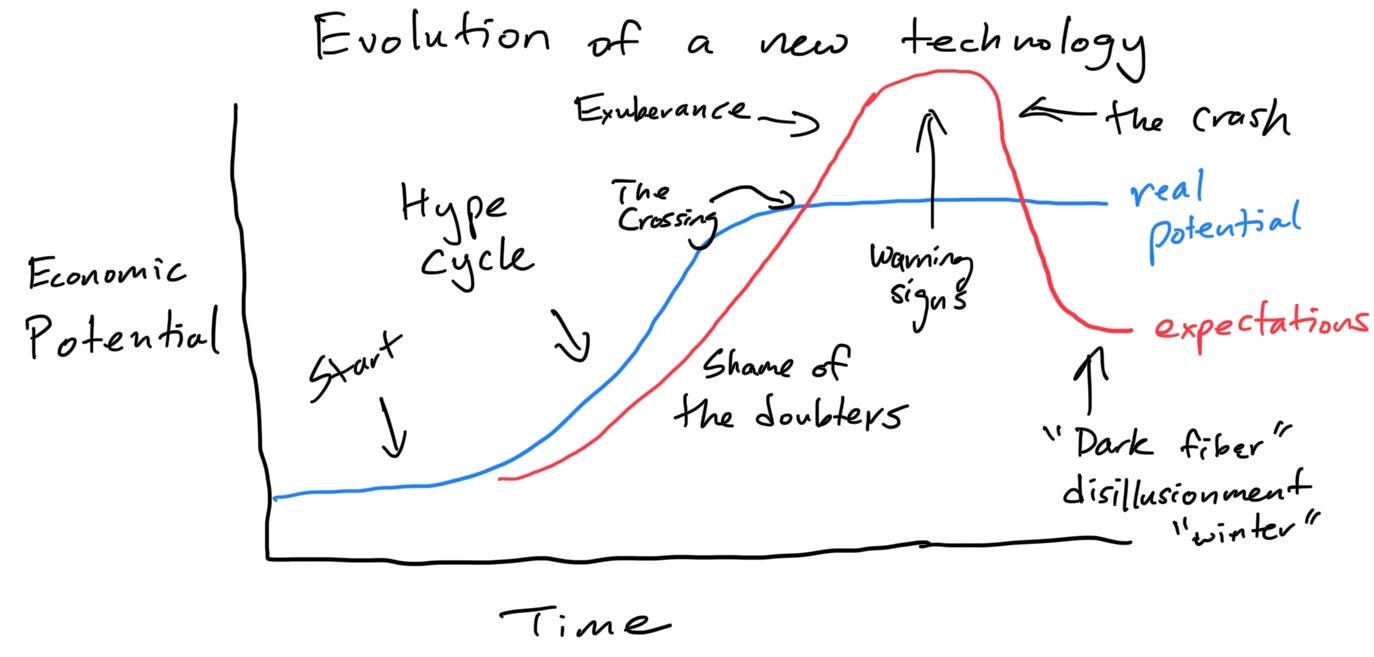
Well, the problem with hype and bubbles is one of over-extrapolation. Below is a stylized chart I made for my piece about AI/tech bubbles. It’s hard to say when a bubble will pop (… maybe it’s already starting to given how the public markets are trending!), but one thing an informed investor can do is compare one’s knowledge of a technology’s capabilities with what the market expects.
This is all well and good, but it’s very abstract. Are the companies today valued in a reasonable way, or are we in fantasy-land? You can at least look at public company valuations, but what do they even mean?
Beyond that, can you do anything to value a private company?
Well, it’s rough but it’s doable. Let me show you how.
The steps are:
Have some idea what the real capabilities of the technology are.
It’s never going to be perfect—by definition, a new technology is… well… new. But if we have a grasp of how it works, we can know when expectations are far past reasonable.
From there, we can then:
Look at companies—even private ones—and have a sense of if they are valued fairly or not. This article will examine the top AI startup right now, OpenAI.
So, let’s first get into the capabilities.
Large Language Models
In the simplest conceptual terms, an large language models (LLM) is an imitation machine. The more data it has, the better of an imitator it is.
In reality, an LLM does not think. It’s just a statistical machine that pops out the next predicted word, similar to your smartphone’s autocomplete, just with much more data and power.
That’s not to diminish how impressive some capabilities of this “fancy autocomplete” are.
For example, with the power of transfer learning, LLMs have been able to answer “novel” questions incredibly robustly by remixing knowledge (language, domain, etc.) from different fields to come up with answers.
However, it’s important to distinguish what is and is not happening. In a way, you can say that a lot of human behavior is just novel remixing. However, analysis and computation is not that. This is why LLMs generally, even if they get some math problems right, will make perplexing errors randomly. They aren’t actually reasoning. It’s still a statistical predictor, just like if you typed in a particular math problem on your smartphone a lot, it too would get the right answer, but you would never expect it to consistently do so.
Additionally, you’d never rely on these models for something like actual business or financial analysis. You may have heard about “hallucinations” where LLMs “make up” knowledge (including, famously, court cases by a hapless lawyer who tried to have an LLM do his homework). This isn’t a “bug” though—it’s fundamental to how LLMs work and why they can do interesting things to begin with. It also means that it’s hard-to-impossible to “remove” that behavior. How useful would your autocomplete be if you removed all ability for it to predict on things except within a narrow subset of existing documents? Not very.
Even so, there are still plenty of interesting applications.
Most customer service chats are indeed similar, even in terms of when the situation turns extreme. Most essays, grants, and even mass-produced internet articles are also indeed similar and can easily be produced by an imitation machine.
However, this is quite a different problem set than designing new materials. Or protein folding. Or solving novel math proofs. AI can be applied here (e.g. AlphaFold and AlphaProof), but not LLMs.
Because LLMs aren’t reasoning machines, the areas in human life where they can be safely and effectively applied to are limited.
Now, with that rough sense of the capabilities of LLMs, let’s get into valuations.
Is OpenAI Overpriced?
It's always difficult to use financial projections on startups in new markets.
Take it from me—how do you reasonably "smoothly" project the valuation of a company that goes from $0 in revenue to signing a $1B+ contract (an actual case in my venture firm’s portfolio)?
This is obviously even harder with companies that are private and do not regularly report standardized financial metrics.
What I’m about to do is more art than science—but all valuations must start somewhere.
As a roadmap to valuing OpenAI, we will:
Gather information
Use that information to derive valuation estimates
Work backwards from those valuations to determine expected revenue growth
1. Information Gathering
Here’s some (limited) information on how the market approximate values OpenAI:
OpenAI is reported to be on track for around $3.5B in annualized revenue.
It was on track to burn $5B this year (after revenue)—so, reported -$5B in earnings
We can start to get a hazy picture of the company’s financial circumstances with all of this information and “typical convention” in private markets and venture.
2. Estimated Valuation
What information do we have? Well, we literally have valuation. So, are we done? Not really. First off, not all valuation is equal (as we’ll get into). Second, we have the old valuation, which includes a risk premium. What we want is the future valuation that the startup is expected to achieve—and hence, understand what the implications for the startup’s expected growth are.
Startups/private equity deals inherently have common expectations/risk premia built into them, so we can start there.
First off, all of finance is built around time value. As such, we need to know what horizon investors are budgeting/valuing for.
Most startups raise to last 18 months until they hit their next round. This latest round was a tender, allowing employees to cash out at the high valuation, which doesn’t count—it didn’t infuse in capital. The last actual capital raise was probably the $10B from Microsoft in January 2023.
If we were to take the normal “18 months” rule of thumb, they’d already be out of cash. So, is this wrong? Let’s take a closer look, especially in light of their earnings.
Let’s assume the company burned a similar amount last year. That would leave them with $5B to work with for 2024.
Interestingly, most reporting seems to suggest $3B revenue was higher than expected. If so, as it got realized, it could have helped push out OpenAI’s 18-month timeframe.
How far? Well, $3B/$10B = 30% so “saving” that amount (by earning it in revenue) would then increase your cash runway by that much.
That would turn 18 months into around 23 months—and roughly square with the picture we have now (reported by The Information, which did a similar analysis though a different way). As such, this horizon seems right.
Let’s move on then to triangulating what valuation they were meant to have for their next raise.
In 2023, Microsoft valued OpenAI at $29B. Using expectations for PE/VC, an investment should at last have around 35% IRR at minimum (given risk, one would usually require more than this, but let’s take a lower bound), which lands OpenAI at around $45B within an 18-month timeframe.
Given this, the company likely has leeway between this figure and $80B.
I’m not going to bother up-valuing the $80B to a next round, and just keep it as the “top end” estimate (… these kinds of tender offers often don’t go well for investors).
3. Implied Revenue and Growth
Multiples of various kinds are popular in finance because they’re easy. The problem is they aren’t particularly accurate and they can only tell how a stock is valued relative to another one—not how good a stock is on an absolute basis. Nonetheless, it’s a useful tool when we have very limited information, like in our case here.
At a $45B valuation and a $3.5B revenue, OpenAI has a 13X revenue multiple, which is rich, but not completely insane. If we go with $80B, this is a 27X revenue multiple, which is starting to get to ridiculous-land (it resembles inflated earnings multiples of hot tech companies).
For comparison, see the index on annualized recurring revenue multiples for SaaS companies below. Yes, I know AI isn’t “SaaS” but many investors still use SaaS multiples—which are the most prevalent within tech—to roughly benchmark companies in widely disparate fields.
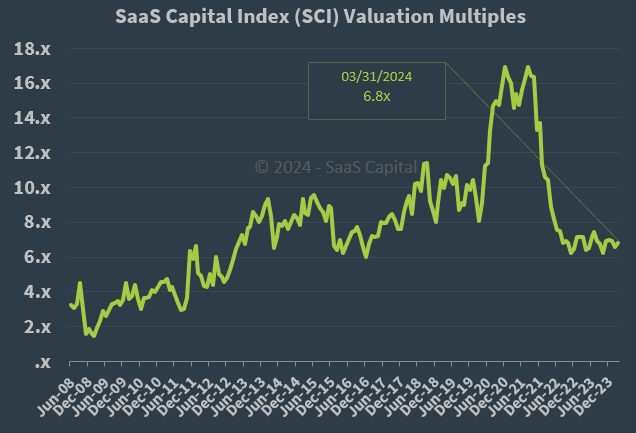
This chart only goes until the end of 2023, but from my own observations in the market, this is still roughly right, with 6-7X revenue multiples being market mid-point.
So, this says that even at the “reasonable” valuation expectation, OpenAI is inflated. 13X revenue multiple is basically twice the average. What does this actually mean, though? Does it mean OpenAI is overvalued?
Now, as said, you can’t directly turn revenue or earnings multiples into earnings expectations, but you can use them on a relative basis.
So, let’s ask: why would you pay a higher revenue multiple for one company vs. another? Well, if the company is expected to grow much faster, of course. It’s the same reason why you would pay a relatively lower earnings multiple on a “value stock” but be willing to pay a much higher one for a high-flying tech or “growth stock.”
A common way in public markets to compare earnings multiples is to divide them by 3-year forward earnings growth. If you end up at similar numbers, the stock is priced similarly relative to growth. Applying a similar concept, we can “solve” for X: in this case, implied revenue growth for OpenAI given its multiple.
We just need what the market is pricing in for revenue growth for the “average” company sitting at around 6.5X revenue multiple. Again, from SaaS Capital’s helpful data:

20%+ growth expectations on the high-end for “average” multiples is around right from my experience in private markets.
Ok, so what does OpenAI’s revenue multiple range of 13-27X mean? Well, that implies (relative to market average of 6-7X) between 2–4 times an equivalent private SaaS’s expected growth rate.
This means the market is expecting 40-80% growth for OpenAI over the coming years. Let’s look at what this means for the company’s top line revenue.
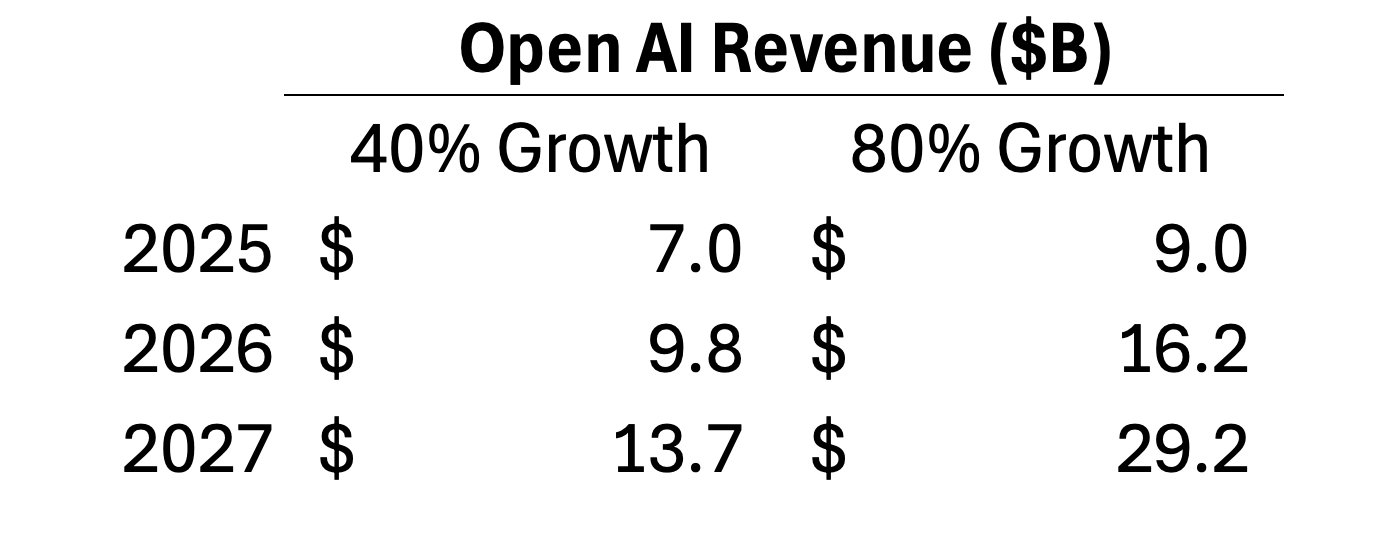
Does this mean OpenAI is overvalued?
In a world where Google and Microsoft’s annual revenue are >$250B, this might not look insane. However, these are also the most massive companies in the world, who dwarf many countries’ GDP.
Let’s instead look at another massive VC unicorn, Salesforce, who in April 2024 had a trailing 12-month revenue of $35.7B. Meaning, recently, like 20 years after its IPO.
Is $30B in 2027 revenue reasonable for OpenAI?
I mean, maybe! OpenAI is a new, innovative company that could keep expanding to new industries and application areas and monopolize the new AI world.
Except, of course, as we explained, LLMs have their limits. That expansion potential is far from limitless. Even Goldman recently came out with a report questioning whether or not Gen AI is actually worth much at all.
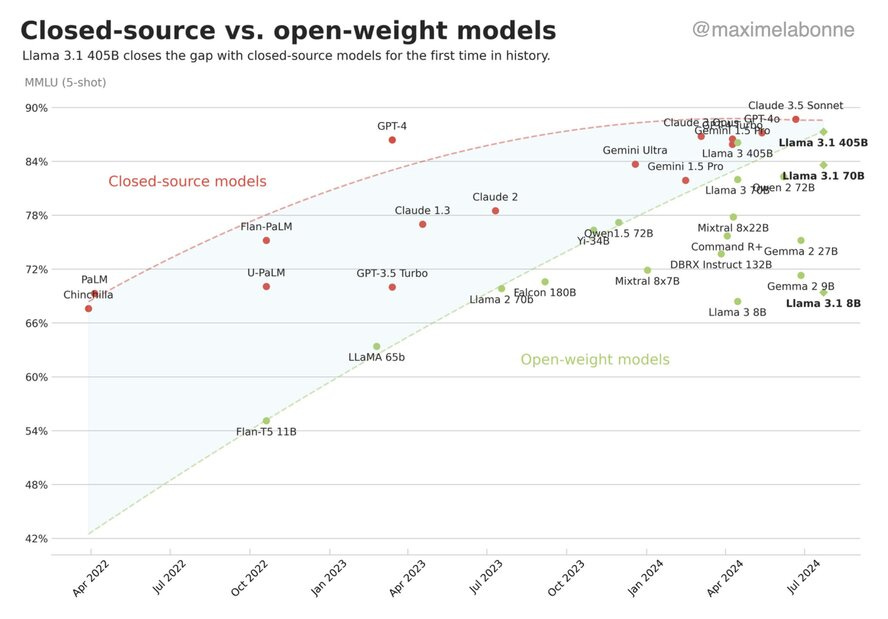
Additionally, that “monopoly” is likely quite fragile—or non-existent. OpenAI isn’t alone in having powerful LLMs. In fact, open-source models, as I’ve written recently and as Maxime Labonne nicely illustrates, have mostly caught up.
As such, there are many reasonable questions about whether OpenAI can actually double annual revenue from $5B in two years.
Now, to be fair to OpenAI, it’s a new technology and they’ve already grown a lot. It isn’t in the realm of “completely insane.” It is a stretch, but it’s a conceivable stretch.
As you would expect from a round priced by professional investors, it’s not so ridiculous as to be laughable. It’s just unlikely given the headwinds that have already shown up—including the limits of the technology which we discussed. If you look at the LLM performance chart above, you can see it’s already leveling off.
Now, the tender offer’s $80B valuation with 3X revenue in 2 years and SalesForce-revenue in 3? That’s a much larger stretch. But, as said, investors often don’t do great in these tender offers…
… But who cares? After all, companies miss lofty expectations all the time.
Well, relative to a company that’s in a more secure cash position, or in public markets with more financing options, this is a more serious problem if OpenAI misses growth expectations.
OpenAI is a vibe check, every fundraising round
OpenAI is going to run out of cash and need to raise again. As Sam Altman said, OpenAI is “the most capital-intensive startup in Silicon Valley history.” They need to keep raising, and expectations must continue to stay high for them to maintain the funding treadmill.
If they miss… well, things will get messy. Probably disastrously so.
So, is it actually overvalued?
Wait, so after all of this, is OpenAI overvalued?
Well, you tell me based on some (quick) understanding of the tech, and now a benchmark for the kind of growth OpenAI needs to achieve. Whether that number looks eminently achievable or utterly insane is in the eye of the beholder—or market participant.
I think it’s clear that I think it’s a stretch, at best. But you may disagree. The point was to be able to work out the analysis to get something we can actually think about—and clearly debate—versus some opaque last-round valuation that’s meaningless on its own.
Now, keep in mind, all of this is rough to an extreme. There’s a lot of flaws. Multiples-based estimations are crude by nature. The information gathered could be wrong. We may be (and likely are) missing some major inside product/roadmap information. SaaS is not the exact right industry. One could find other comparables for the multiples. You could think the Singularity is about to happen. And so on and so forth.
But, as an investor, you have to start somewhere. And, as an investor within the deep tech space (including AI), with both some sense as to the tech and the market, this is how I’d break it down with just public information.
You could very well entirely disagree for either analytical reasons (you could use different kinds of multiples/methods), or for fundamental reasons (like your expectations about the technology and the achievability of the implied growth).
Well, that’s what makes a market. And hopefully, this was helpful for readers to think about how they might start valuing something as gigantic and nebulous as OpenAI.
And that was James Wang from Weighty Thoughts!
If you liked what you saw, definitely head over and take a look.
Gonna have to come back to this when my brain turns on 🤣
Really appreciate stepping through how you approach valuing OpenAI. I’d love a post for a generic method on valuing companies, maybe some tidbits of personal experience tossed in.
I don’t think the future of AI is overhyped, the money probably just isn’t going to flow like it’s been hyped. I went back and looked at QQQ’s history and was kinda stunned that the dotcom peak wasn’t met again until 2011 or so. But after some thought, I think that was reasonable. Smartphones didn’t really cement themselves into every day life until 2010 or so.
So, we’re all those investors wrong about the revolutionary impact of the internet? Or were they all too early? Too early for us to know the impact, too early for companies to learn how to monetize the internet, too early to know how consumers would respond ($$$)?
I think AI is in a somewhat similar place (history rhymes), except we have a small history of learning how to monetize and develop SaaS. Of course much of the AI boom is lead by real money flows to NVIDIA, but we’re yet to see if the money spent on AI pulls more money from consumers. Should be coming soon….i think google et al earnings are coming late aug.
I think most tech companies have a clear idea of how to improve their products with AI, I don’t think they have a clear idea of how it increases revenue or profit though. I think everyone just doesn’t want to be last to the AI party, and that’s super understandable.
My guess is…no long lasting significant increase in sales for things like smartphones and personal devices that will actually bring AI into our lives. Probably a significant but temporary “upgrade” bump in sales as people want to try it out.
I think it’s much more likely AI saves costs in areas like call centers and alleviating mundanity from more complex roles.
I think that will take some time to really be appreciated, and is also very “unsexy” and not what everyone is looking for in all this hype.
These are my personal thoughts and not tied to any real research. I come here for research 😅